What Makes Shotokan Different from Other Karate Styles?
If you've started looking into karate classes, you've probably noticed that "karate" isn't one thing. Shotokan, Goju-ryu, Shito-ryu, Wado-ryu, Kyokushin, different dojos teach different styles, and most websites assume you already know the difference.
You don't need to. But it helps to understand what you're signing up for, because the style shapes how you'll move, how you'll train, and what karate will feel like six months in.
Here's a plain-language look at what makes Shotokan distinct, and why it's the style we teach at our dojo in Tecom.
Where Shotokan Comes From
Shotokan traces back to Gichin Funakoshi, the Okinawan master widely credited with bringing karate to mainland Japan in the 1920s. The name comes from his pen name, Shoto (meaning "pine waves") combined with kan, meaning hall. Students named the training hall after their teacher, and the style took the name from there.
Funakoshi's son, Gigo Funakoshi, then reshaped the style significantly, deepening the stances and extending the range of the techniques. That generational shift is why Shotokan looks the way it does today: long, low, powerful, and built around covering distance.
Understanding this matters because it tells you what Shotokan is for. It isn't a close-quarters grappling art or a sport-first competition system. It was designed to develop maximum power delivered from a distance, with the whole body behind a single technique.
The Physical Signature: Long Stances, Linear Power
If you watch a Shotokan class next to a Goju-ryu class, the difference is visible within ten seconds.
Deep stances. Shotokan is known for long, low positions like zenkutsu-dachi (front stance) and kiba-dachi (horse stance). Beginners often find these harder than expected, and that's the point. Deep stances build leg strength, hip mobility and balance, and they teach you to generate force from the ground up rather than from the arm alone.
Linear movement. Shotokan techniques travel in straight lines toward the target. Many other styles favor circular blocks and redirections. Shotokan tends to move directly, closing the distance and committing.
Long range. Shotokan practitioners typically fight and train from further out than practitioners of close-range styles, using distance and timing rather than clinch work.
Hip rotation. Almost every correction you'll hear from an instructor in a Shotokan dojo comes back to the hips. Power in Shotokan comes from rotating the body into the technique, not from muscling it.
One decisive technique. The underlying philosophy is ikken hissatsu, the idea of finishing with a single well-placed strike. In practice this means training fewer techniques to a higher standard rather than accumulating a large volume of them.
How It Compares to the Other Major Styles
Goju-ryu translates roughly as "hard-soft." It works at close range, uses circular blocking, and places heavy emphasis on breathing and body conditioning through kata like Sanchin. Where Shotokan reaches, Goju-ryu closes.
Shito-ryu blends the two main Okinawan lineages and is known for having one of the largest kata catalogs in karate. It's broader and more varied, where Shotokan is deliberately narrower and deeper.
Wado-ryu carries a strong Japanese jujutsu influence. It uses lighter, higher stances and prioritizes body shifting and evasion over meeting force with force.
Kyokushin is full-contact knockdown karate, bare-knuckle body strikes, no punches to the head, and a strong conditioning culture. It's the most physically punishing of the mainstream styles.
None of these is objectively better. They answer different questions. Shotokan's answer is: build a strong foundation, generate real power from the ground, and make every technique count.
What This Means for You as a Beginner
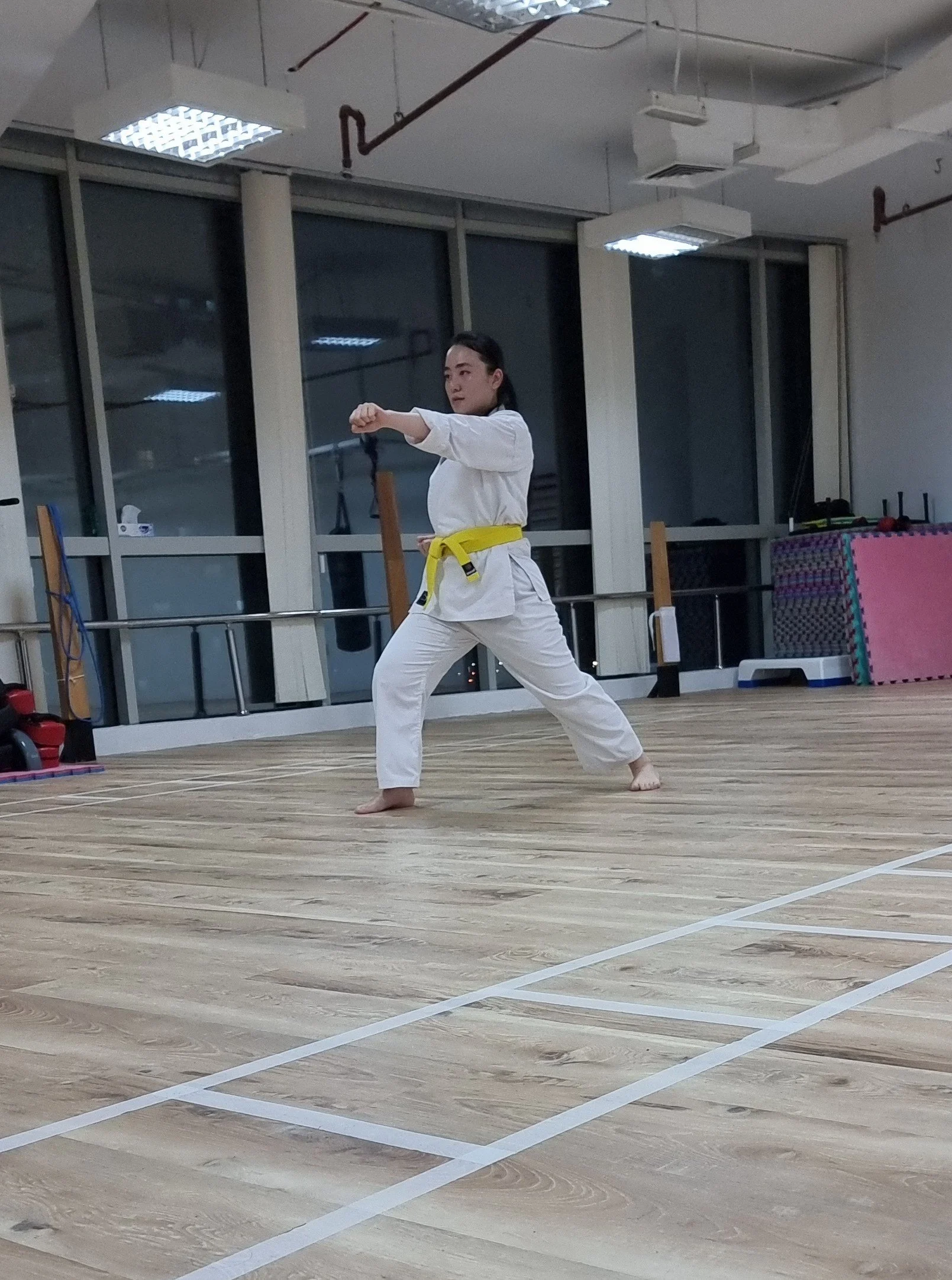
Shotokan tends to suit people who want structure. Progress is measured, the syllabus is clearly laid out, and the belt system gives you visible checkpoints. Training is organized around three pillars: kihon (basics), kata (forms), and kumite (sparring) — and every class touches at least one of them.
It's also unusually accessible. Because the emphasis sits on technique rather than raw athleticism, Shotokan works for a seven-year-old and a fifty-year-old in the same building. You don't need a fitness base to start. The stances will build it.
The trade-off is that Shotokan asks for patience. You'll spend a lot of early hours on a small number of movements. Students who want fast, flashy results sometimes find that frustrating. Students who stay usually say it's the reason the art stuck.
Training Shotokan in Dubai
At Traditional Martial Arts & Fitness in Tecom (Barsha Heights), we've taught Shotokan karate since 2013 under Chief Instructor Sensei Faramarz, a 6th dan black belt with over 50 years of training. Our classes run for children from age four and for adults at every level, including complete beginners.
If you'd like to see what a Shotokan class actually looks like before committing, the best way is to come and watch one.
View our class schedule or get in touch to arrange a visit.